20 July – 7 August 2010 – Szeged, Hungary: Michael Sommer won the Open Class flying the EB29, and Pierre de Broqueville took third place with the EB28 edition.
We congratulate the winners of the 2010 World Gliding Championships on their success, and all participating pilots on their excellent performances!
We are delighted with the outstanding results achieved by Michael Sommer — who secured his third World Champion title in the Open Class — by Pierre de Broqueville in third place, and by the other six “EB pilots.”


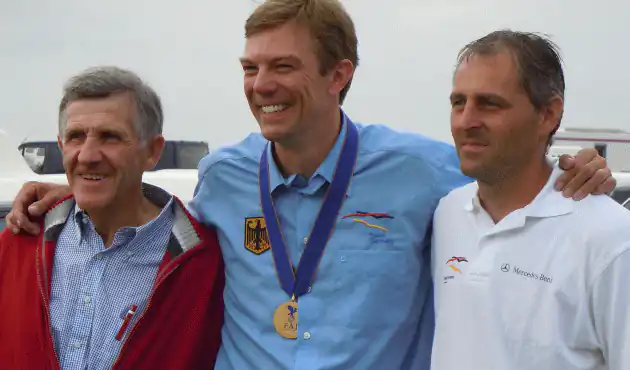
Michael Sommer: A Year with the EB29
For me, it all began in August 2009. At the German Nationals in Mengen, the word spread that the Binder company was developing a single‑seater based on the EB28 edition wing — the EB29.
Having had ample opportunity in Mengen to observe the excellent performance of the EB28 edition up close, this naturally grabbed my attention. Replacing the large two‑seater fuselage with a sleek, aerodynamically efficient single‑seater promised superior performance compared with traditional Open Class sailplanes.
At the end of October, I visited Ostheim for the first time.
The weather was poor – flying was impossible – but I was able to see the aircraft assembled in the hangar. A sharp, slender wing with light sweep and elegant winglets, a spacious cockpit – the glider looked magnificent. The first EB29 was far from an experimental prototype; everything was perfectly positioned and beautifully built.
Walter Binder wanted to present the EB29 at the 2010 World Championships in Hungary, while I was searching for a competitive glider for the same event, aiming for my third consecutive world title…
Mid‑March – the first flight in Ostheim.
Even with empty water ballast, I immediately got an idea of how the EB29 flew. Its handling was easy and well‑balanced. The glider felt steady in the air, the wing comparatively stiff and giving a clear sense of the thermals.
The manoeuvrability, considering the wide wingspan, was astonishing. A week and a half later I was back in Germany, and together with Walter, Petra, Uli Schwenk and myself – two trailers on the road – we headed south to Varese, Italy.
I had plenty of opportunity
to familiarise myself with the EB29, while Walter and Uli flew the EB28 edition. For four days we flew together across the southern Alps, deep into southern France and to the Mediterranean. Flights none of us will ever forget. For anyone familiar with conventional Open Class gliders, switching to the EB29 was effortless.
After a week of flying, I felt completely at ease – even close to the mountains. At low speeds the two aircraft felt evenly matched; at higher speeds the EB29 had, as expected, the clear advantage.
Walter smiled, and so did I…
By mid‑May there was one last chance for a training week before the Worlds — but unfortunately, heavy rain at Hahnweide curtailed flying to just three usable days. Still, it was good to get back in the air.
Then it was time. On 17 July I landed in Frankfurt at 6 a.m. after returning from Shanghai, where I was living at the time. The next day I took advantage of good weather for a final training flight from Altenbachtal in the EB29. Given the narrow strip, I launched at 820 kg — as it turned out, completely unnecessarily.
The engine had power in abundance; I climbed high over the trees at the end of the runway. After nine hours and 1,000 OLC kilometres, I was re‑acclimated after nearly two months without flying.
The aircraft is a dream.
The 2010 World Championships were marked by unusually humid conditions for that time of year. Wet ground and warm, moist air produced low bases, occasional thunderstorms and early thermal cutoff. My strategy from day one was to take no unnecessary risks under such uncertain weather, focusing instead on avoiding large losses. On weak days it’s easier to lose than to win — the goal was to survive the bad days well and push hard once conditions improved.
The superior performance of the EB29 made this strategy easy to follow. Especially in narrow, weak thermals, the high‑aspect‑ratio wing performed brilliantly. At 850 kg and 45° bank the aircraft felt rock‑solid at about 100 km/h, outperforming competitors clearly in climb. The high‑speed end of the envelope – around 180 km/h and beyond – could rarely be exploited that year, but its advantage was unmistakable.
With a little luck, the plan worked.
Gradually the favourites dropped back after poor contest days. I was surprised myself to take the overall lead already by day five — without yet having attacked aggressively in clear weather. The decisive moment was on day three, when only seven pilots managed to complete the task. On days six and seven conditions improved, allowing faster speeds and an increased lead. The final contest day brought low bases (around 800 m), but flying in team formation with my German teammates for the first time, I managed another day win.
The joy is indescribable!
I was thrilled to have done it once more — and even happier that the Binder team’s work paid off, allowing me to demonstrate the EB29’s superiority. That’s the real success — Binder’s achievement. The company’s evolution over the decades — from a power‑system specialist to the manufacturer of what is arguably the finest glider in the world — is truly extraordinary.
My heartfelt congratulations to the Binder team for their determination, persistence and uncompromising dedication. This victory is yours. I’m proud to have been part of “Team Binder – World Championship.”
Thank you!